Chapter 5. Selection & Interfaces
Core product specifications, selection criteria, and interface standards for road video surveillance equipment
Equipment selection for road video surveillance systems requires balancing technical performance, environmental suitability, interoperability, and total cost of ownership. The core products — cameras, switches, storage, and management software — must be selected as an integrated system, not as individual components. Interface standards such as ONVIF, RTSP, and PSIA ensure interoperability between products from different manufacturers, but the level of compliance varies significantly, and testing is required to verify that the selected products work together as specified.
5.1 Core Product Overview
The following image presents the six core product categories in a road video surveillance system. Each product category has distinct selection criteria, and the selection of each product must be validated against the requirements of the specific deployment scenario.
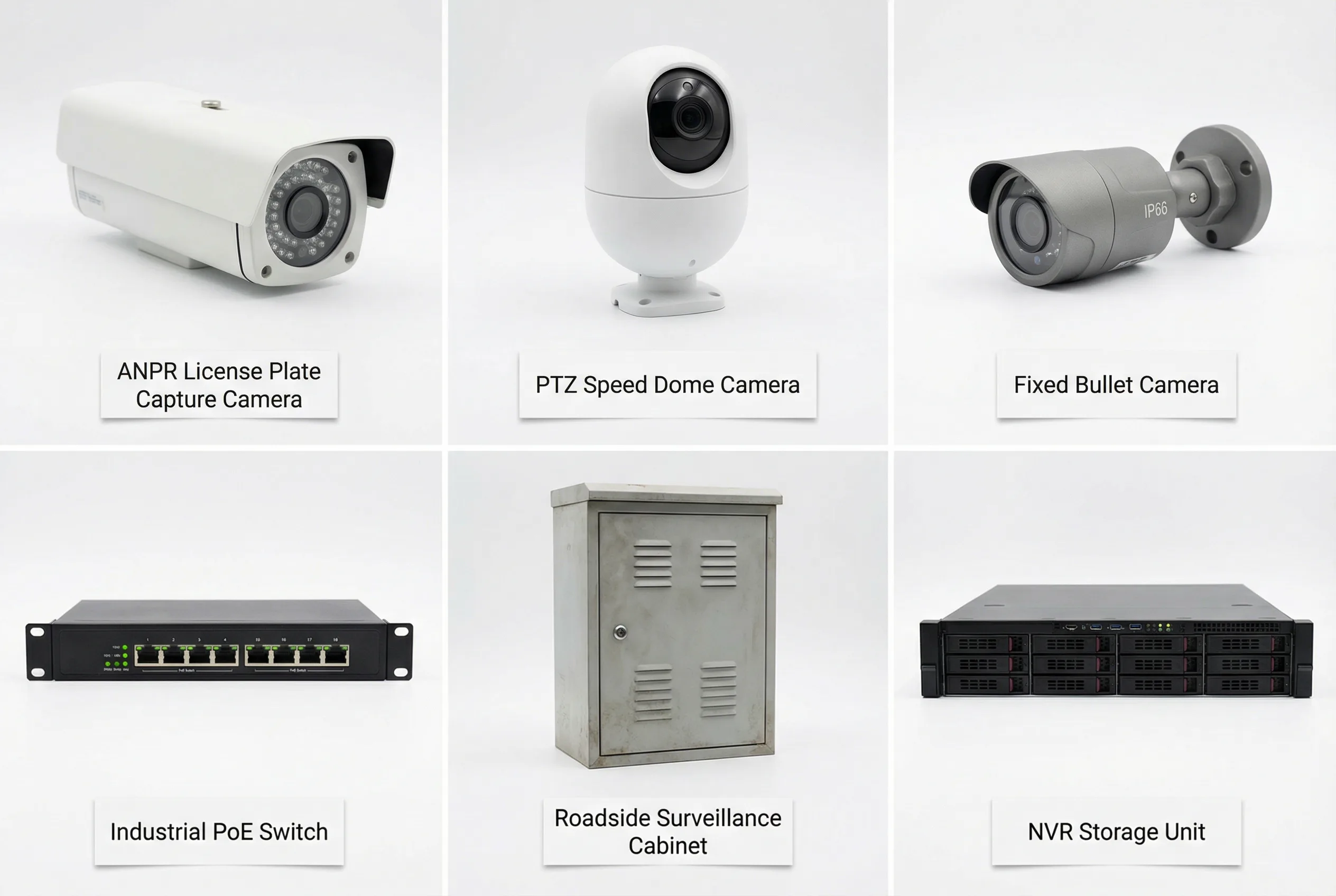
Figure 5.1: Core product categories for road video surveillance systems — ANPR License Plate Capture Camera, PTZ Speed Dome Camera, Fixed Bullet Camera, Industrial PoE Switch, Roadside Surveillance Cabinet, and NVR Storage Unit. Each product is selected based on the specific deployment scenario requirements.
5.2 Camera Selection Criteria
Camera selection is the most critical and scenario-dependent decision in the system design process. The following table presents the key selection criteria for the three primary camera types used in road surveillance systems.
| Criterion | ANPR Capture Camera | PTZ Speed Dome | Fixed Bullet/Box |
|---|---|---|---|
| Primary Function | License plate capture; violation evidence | Wide-area overview; incident tracking | Continuous recording; overview |
| Resolution | 4–8 MP; high pixel density at plate | 2–4 MP; wide FOV at full zoom-out | 2–4 MP; fixed FOV |
| Sensor Size | 1/1.8" or larger; high sensitivity | 1/2.8" or larger | 1/2.8" or larger |
| WDR | ≥ 120 dB; true WDR (not digital) | ≥ 100 dB | ≥ 100 dB |
| Shutter Speed | 1/1000 s minimum; 1/10000 s preferred | Auto; 1/100 s minimum | Auto; 1/100 s minimum |
| IR Illumination | Dedicated IR array; 30–80 m range | Built-in IR; 100–200 m range | Built-in IR; 30–80 m range |
| Focal Length | Fixed or motorized; 8–50 mm typical | 20–30× optical zoom; 4.7–94 mm | Fixed or varifocal; 2.8–12 mm |
| Operating Temperature | -40°C to +70°C | -40°C to +60°C | -40°C to +60°C |
| Protection Rating | IP66; IK10 | IP66; IK10 | IP66; IK10 |
| Power | PoE 802.3at (30W) or DC 12V/24V | PoE 802.3at (30W) or DC 24V AC | PoE 802.3af (15.4W) or DC 12V |
5.3 Core Product Feature Summary
ANPR License Plate Capture Camera
- True WDR ≥ 120 dB for backlight immunity
- Shutter speed ≥ 1/1000 s for motion freeze
- Dedicated IR illuminator array (850 nm)
- On-board ANPR engine (optional)
- Alarm I/O for trigger input (radar/loop)
- RS485 for external illuminator control
- IP66 + IK10; -40°C to +70°C
PTZ Speed Dome Camera
- 20–30× optical zoom; motorized focus
- 360° continuous pan; ±90° tilt
- Preset positions with ± 0.1° accuracy
- Auto-tracking analytics
- IR illumination 100–200 m range
- Wiper for rain/fog environments
- IP66 + IK10; -40°C to +60°C
Industrial PoE Switch
- 8–24 PoE ports; 802.3at (30W per port)
- 2× SFP uplink ports for fiber ring
- ERPS (G.8032) ring protection
- VLAN, QoS, IGMP snooping
- DIN-rail or rack mount
- Operating temp: -40°C to +75°C
- Total PoE budget ≥ 240W
NVR Storage System
- Supports 64–256 IP camera channels
- RAID 5/6 for data protection
- H.265/H.264 hardware decoding
- ONVIF Profile S/G compliance
- Redundant power supply
- Hot-swap HDD bays
- Storage capacity: 8–128 TB per unit
5.4 Interface Standards and Wiring Logic
The interface diagram below illustrates the complete set of interfaces on a typical ANPR camera, showing both the physical connectors and the logical protocols used for each interface. Understanding this interface map is essential for system integration, as each interface must be correctly configured and connected to achieve the intended system functionality.
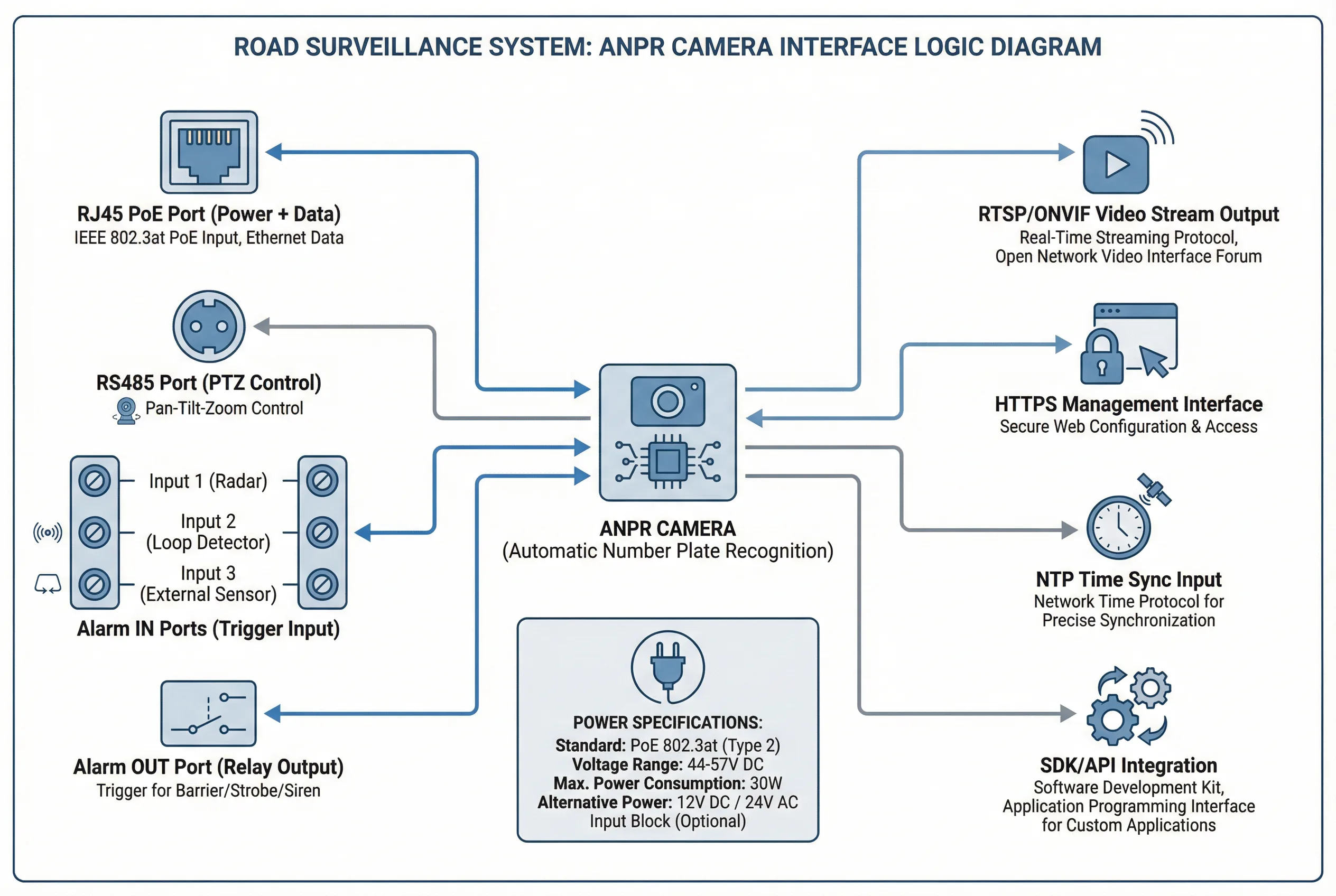
Figure 5.2: ANPR camera interface logic diagram — showing all physical and logical interfaces: RJ45 PoE (power + data), RS485 (PTZ control), Alarm IN (trigger inputs from radar/loop detector), Alarm OUT (relay output), RTSP/ONVIF video stream, HTTPS management, NTP time sync, and SDK/API integration. Power specifications: PoE 802.3at, 30W maximum.
5.5 Interface Protocol Standards
The following table summarizes the key interface protocols used in road surveillance systems and their specific requirements for road surveillance applications.
| Protocol | Function | Road Surveillance Requirement | Compliance Level |
|---|---|---|---|
| ONVIF Profile S | Video streaming, PTZ control, event notification | Mandatory for all cameras; Profile S minimum | Verified by ONVIF conformance test |
| ONVIF Profile G | Recording and playback management | Required for NVR integration | Verified by ONVIF conformance test |
| RTSP/RTP | Real-time video streaming | H.265 main stream; H.264 sub-stream | RFC 2326; RFC 3550 |
| HTTPS/TLS | Secure management interface | TLS 1.2 minimum; certificate authentication | Mandatory for all networked devices |
| NTP | Time synchronization | Accuracy ≤ 1 ms to GPS reference; mandatory | RFC 5905; Stratum 2 or better |
| RS485 / Pelco-D/P | PTZ control (legacy) | For PTZ cameras without IP control | Pelco-D or Pelco-P protocol |
| SNMP v3 | Network device management | For switches and network equipment | SNMPv3 with authentication and encryption |
| SDK/REST API | Platform integration | For VMS and analytics integration | Vendor-specific; document required |
5.6 Switch and Network Equipment Selection
The industrial PoE switch at each roadside cabinet is a critical component whose failure causes a complete outage at that surveillance point. Switch selection must prioritize reliability and environmental suitability over cost. The following criteria should be applied when evaluating switch options for road surveillance deployments.
| Selection Criterion | Minimum Requirement | Preferred Specification |
|---|---|---|
| Operating temperature | -40°C to +70°C | -40°C to +75°C (fanless preferred) |
| PoE standard | IEEE 802.3at (30W per port) | IEEE 802.3bt (60W/90W) for future cameras |
| PoE budget | ≥ 30W × N (N = camera count) | ≥ 150% of calculated load |
| Ring protection | ERPS (ITU-T G.8032) | ERPS v2; convergence < 20 ms |
| Uplink ports | 2× SFP (1G) | 2× SFP+ (10G) for high-density nodes |
| MTBF | ≥ 100,000 hours | ≥ 200,000 hours |
| Surge protection | 4 kV on all ports | 6 kV on PoE ports; 15 kV on fiber |
| Management | Web GUI; SNMP v3; CLI | NETCONF/YANG; REST API |